
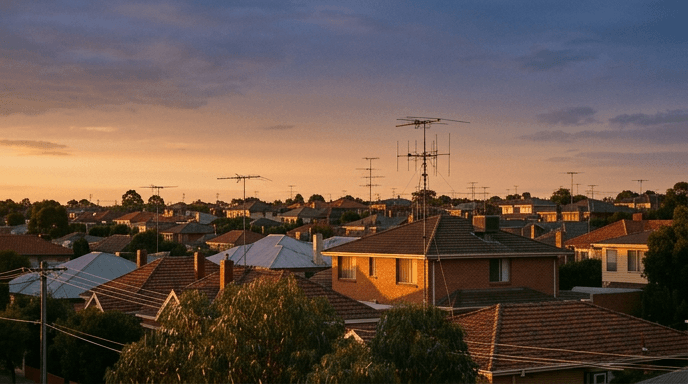
Future of Australian Television Part I: The Terrestrial TV Endgame
Australia's free-to-air television faces critical decisions regarding its terrestrial platform and UHF spectrum, with
David Kennedy · Venture InsightsPeriod: 2020-202615 min read
Last updated
Compound annual rate of decline in free-to-air advertising revenue (2022-2025)
Year Australia completed analogue-to-digital switchover
Abstract
This report examines the transmission-and-spectrum question at the heart of Australian free-to-air television's future. For free-to-air broadcasting, what happens to the digital terrestrial television (DTT) platform and the UHF frequencies it occupies is not one issue among many – it determines the platform's cost base, its reach, and ultimately its viability. Content obligations, prominence rules and ownership changes are best understood as context that changes the payoffs on the transmission choice rather than as separable questions. The analysis sets out the four ways the terrestrial platform can evolve; traces how the 2020 Media Reform Green Paper posed the spectrum question, and how the reforms that have since landed reshaped its payoffs without resolving it; and compares Australia's position with Canada, the United Kingdom, New Zealand and the European Union through the transmission-and-spectrum lens. It concludes that Australia has become the outlier mainstream on content regulation, yet alone among its close regulatory peers in having no published plan for its terrestrial endgame. A companion report carries the argument forward into integrated market scenarios to 2035 and their strategic implications.
Key Takeaways
- Australia's free-to-air television faces a critical juncture regarding its terrestrial platform and UHF spectrum, with the 2020 Green Paper's core questions still unresolved.
- Four potential evolution paths exist for the terrestrial platform: a consolidated safety-net, an upgrade to DVB-T2/HEVC, complete online migration, or unmanaged decline.
- The 2020 Green Paper proposed a 'New Licence' to shrink the terrestrial footprint and reallocate spectrum, but failed to achieve consensus on the spectrum trade.
What's Inside
The transmission question at the centre
The policy and market context that reframes the choice
International comparison through the spectrum lens
1 figure & data tables inside
Charts, tables, and data visualisations
Figure 1. Long-term free-to-air (FTA) TV transmission scenariostable
Log in to keep reading
3-section deep analysis · 1 figure & charts · stakeholder implications · PDF download
Frequently Asked Questions
Venture Insights Access Plans
Unlock the full report
Access in-depth analysis, interactive figures, and stakeholder insights from Australia's leading media and technology research firm.
Free
No credit card required
Read previews on every report and buy individual reports as needed.
- Executive summaries on every report
- Weekly briefing email
- Sector alerts
- Buy individual reports
Lite
$350/mo ex-GST · 12-month minimum term
10 full reports/month
- 10 reports/month
- All figures & charts
- PDF downloads
- Stakeholder analysis
Team
$1,000/mo ex-GST · or $11,000/yr upfront incl. GST ($10,000 ex-GST) · 12-month minimum term
Unlimited seats — company-wide access
- 30 reports/month (cumulative)
- Unlimited seats per domain
- Weekly digest + alerts
- Headline forecasts dashboard
New here? Sign up free · Compare all plans including Enterprise →